

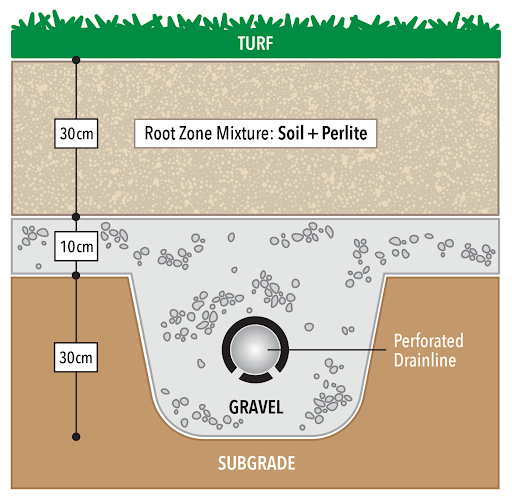
Every superintendent knows the green is only as good as what sits underneath it. It is like building a house – you need a solid and strong foundation to accomplish the desired outcome above ground. Root zone mix (that 300 mm of engineered sand, organic matter, and carefully graded particles) is the single decision that shapes how your greens drain, play, and age over the next two or three decades.
Get it right and maintenance stays predictable. Get it wrong and you are chasing drainage problems, compaction issues, poor root growth and even anaerobic growing mediums which most of the time leads to member complaints for years. In Southeast Asia, the margin for error is thinner than anywhere else on the planet.
Monsoon seasons can lead to up to 200 mm precipitation in an afternoon. Soil temperatures rising past 30 °C for months on end combined with air temperatures of over 40 degrees makes for a difficult task to keep turf healthy and consistent. (SEA only has warm season grasses so it will not recover in any cold or winter months – unlike Bent- or Rye grasses)These are the realities that make tropical root zone specification its own discipline, one where shortcuts get punished fast and re-active measures comes back to haunt you continuously.
This piece covers the core components of a high-performing root zone, what tropical conditions do to soil and roots that temperate guides gloss over, and why material selection at construction locks in outcomes for decades.
What Makes a Root Zone Mix Work for Putting Greens?
Root zone composition. Strip it down and a root zone mix is sand, organic matter, and sometimes peat, compost and most recently J&J’s collaboration with Profile as this has the soil solutions you need to permanently enhance your root zones for improved germination, increased oxygen levels, and greater water and nutrient retention.
Sand particle distribution. The benchmark most courses build against comes from the USGA. Their putting green construction specifications call for a 300 mm root zone layer of specially graded sand over a 100 mm gravel blanket, with strict particle-size requirements (at least 60 per cent of particles between 0.25 mm and 1.0 mm) to maintain saturated hydraulic conductivity of 150 mm per hour or better.
Gravel drainage layer. The gravel blanket creates a perched water table, a thin moisture reservoir at the base of the profile that feeds roots upward while excess water drains out through the pipe network below. Without it, you lose that capillary break and the profile either dries out too fast or stays too wet. There is no middle ground.
Porosity targets. You are aiming for 15–25 per cent air-filled pore space at field capacity. That is what keeps oxygen reaching root tips after a heavy downpour. Sand selection matters enormously here: sub-angular to angular grains interlock and hold structure under traffic. Round grains, the kind you get from most river-dredged sources across SEA, shift and settle, closing off air channels and creating the anaerobic conditions that lead to black layer.
I have seen courses across Batam and Bintan that specified sand purely on price. Within two seasons the greens were holding water in patches, and the superintendent was fighting black layer on six greens simultaneously. Sourcing angular sand in this region takes effort (the geology favours alluvial deposits), but the alternative is rebuilding greens a decade early.
Sand-based vs USGA greens. Here is a distinction worth understanding: not every sand-based green is a USGA green. The USGA Green Section has explained this clearly: many courses use modified or “California-style” profiles that skip the gravel layer or use locally available sand without laboratory verification.
The upfront savings look attractive on a construction budget. Three to five years later, those same courses are dealing with drainage failures, uneven settling, and renovation costs that dwarf what they saved. If you are going to build to USGA spec, build to USGA spec. Half-measures cost more in the end.
How Do Tropical Conditions Affect Root Development and Soil Health?
Tropical climate pressures. SEA courses deal with a triple hit that temperate textbooks barely cover: sustained heat, extreme rainfall intensity, all-year-round high humidity levels and no off-season. Every biological and physical process in the root zone runs faster here. Organic matter accumulates quicker, compaction builds up harder, and disease pressure never truly lets up.
Root depth and organic accumulation. Paspalum, Bermudagrass, and Zoysia, the warm-season grasses that dominate SEA greens, tees, fairways and roughs love the heat. But that aggressive tropical growth also generates organic matter at two to three times the rate of cool-season species. Once organic content rises past 3–4 per cent by weight, water-holding capacity becomes unpredictable due to water penetration that gets limited, surface drainage is restricted which leads to moist and too soft surfaces which has a direct effect on turf health and playability on any golf course or sports field.
Leave it unchecked and you end up with a spongy mat layer just below the canopy that actually repels water, the opposite of what you want. Any superintendent who has managed Bermuda greens through a Southeast Asia wet season knows exactly how fast this can develop.
Compaction. Heavy foot traffic, machinery and maintenance, poor soil composition, excessive moisture, organic matter/thatch accumulation and poor drainage all compresses the upper 10–100 mm of the profile, crushing macro-pores and starving roots of oxygen. Managing compaction is not optional; it is the most physically demanding part of the maintenance programme and secondary cultural practices is of utmost importance
Aeration timing. Most SEA superintendents run aggressive hollow-tine aeration two or three times a year. The ideal time is just before monsoon onset, when warm temperatures and abundant moisture will drive fast recovery. Lighter solid-tine work fills the gaps monthly.
Aerify too late into the wet season and you are left with open holes that recovers slowly, invite disease, and give members something to complain about for weeks. Courses that plan their aeration calendar around monsoon patterns, not around tournament schedules alone, consistently recover faster and lose fewer playing days.
Soil biology. In hot, humid conditions, beneficial soil biology and microbial activity can be your greatest ally or your biggest liability. Healthy microbial populations break down thatch, cycle nutrients, and suppress soil-borne pathogens. In the tropics, these processes run at double speed, which means they can spiral out of balance just as quickly if you are not monitoring.
Work from the Asian Turfgrass Center backs this up: site-specific nutrient programmes consistently outperform calendar-based fertilisation in tropical and subtropical conditions. Lower input costs, better turf density, deeper roots.
A proactive biological strategy (regular soil testing, targeted amendments, microbial inoculants) gives you far more control than chasing problems with reactive chemical treatments after symptoms show up on the putting surface.
Why Does Growing Medium Selection Determine Green’s Performance for Decades?
Long-term investment. A putting green root zone is a 20- to 30-year commitment. The sand and amendments you install during construction become the permanent skeleton of that playing surface. You cannot swap them out without a full rebuild. That makes material specification the single highest-leverage decision in any greens project.
Choose the right sand profile once, maintain it properly, and your greens will perform for decades on routine budgets. Choose poorly, and no amount of topdressing or aeration will fix a fundamentally flawed foundation.
Course A. Built to USGA spec: laboratory-tested sand, correct particle-size distribution, properly constructed gravel drainage layer. Ten years on, this course runs firm, uniform surfaces with routine maintenance and modest topdressing. Total cost of ownership stays flat and predictable. The GM sleeps at night.
Course B. Went with locally sourced, untested sand to trim construction costs. By year three, soft spots appeared. By year five, chronic wet patches after any moderate rainfall. The superintendent started spending 30–40 per cent more on topdressing, wetting agents and penetrants, and extra aeration passes just to keep surfaces playable.
By year ten, Course B’s total maintenance spend had exceeded Course A’s upfront premium by a factor of two, and that is before counting the members who quietly moved their weekend game to a course with better greens. The initial saving on sand looked smart on a spreadsheet. It was the most expensive line item in the project.
Common mistakes. There are many shortcuts for cost savings which includes, but not limited to accepting sand with excessive fines (particles below 0.15 mm), using calcareous or noncalcareous sand that drifts pH upward or downward over time and skipping the gravel transition layer entirely. Each of these creates a root zone that fights you and preventing dry or wet spots and uneven moisture distribution becomes a daily battle rather than an occasional maintenance task.
Always request a physical soil analysis from an accredited laboratory before signing off on any sand supply contract. Compare results against USGA or equivalent regional standards. Skip these steps and you will be rebuilding greens in 8 years instead of 20.
Partnering With JJ TurfTech for Science-Backed Turf Management
JJ TurfTech delivers integrated turf solutions across Southeast Asia, working with industry-leading technology partners including Toro, Netafim, Plant Fitness, Atlas Turf International, Profile and the Asian Golf Industry Federation (AGIF).
Our agronomic team has supported championship venues including Sentosa Golf Club and Kuala Lumpur Golf & Country Club (KLGCC), and many more European Tour Events around the world combining soil testing, irrigation design, and nutrition planning into a single, data-driven programme. From initial root zone specification through to ongoing monitoring thus ensuring that every recommendation is grounded and based on laboratory data and field-validated best practices.
Whether you are building new greens, renovating an ageing profile, or looking to optimize essential nutrients for turf health on your existing surfaces, our team can help. Every engagement starts with a comprehensive soil and water audit, benchmarks your root zone against USGA and regional standards, and delivers a clear action plan with measurable targets and timelines.
Request an agronomic consultation to start the conversation today.