
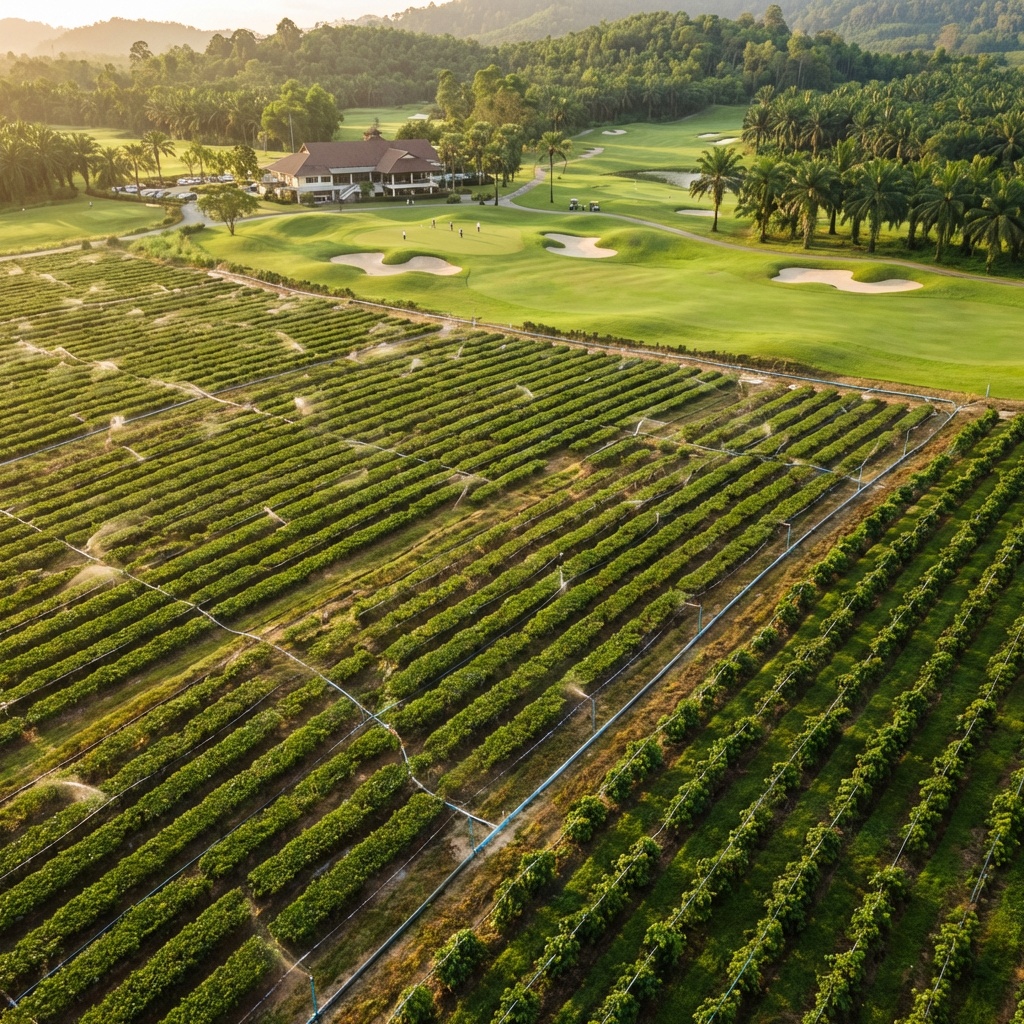
Wide-angle shot showing contrast between sprinkler irrigation on a golf course () background and drip irrigation lines in a plantation () foreground, within a typical Southeast Asian landscape setting
PUBLISHABLE CONTENT STARTS BELOW
The irrigation system you pick will outlast most of the people who chose it. On a small golf course that decision plays out daily across every green, tee and fairway. On a large oil-palm estate it determines whether you hit yield targets or haemorrhage water for years to come.
The efficiency gap between methods is stark. Modern drip technology delivers industry-leading water use efficiency. Sprinkler systems sit in a solid mid-range, still the workhorse for turf and broadacre crops. Flood methods fall well below either, with most of the loss soaking into laterite subsoils or running off before roots ever see it.
Field trials consistently show well-designed drip systems meaningfully improving yields over surface irrigation. But those headline gains shift depending on crop type, local climate, and how well the system is actually managed day to day.
Efficiency alone does not settle the question, though. Terrain, soil type, crop variety, labour availability, and the regulatory landscape in each Southeast Asian market all push the design in different directions. A resort campus outside Phuket has completely different constraints from a rubber plantation in Johor.
This guide walks through the main commercial and agricultural irrigation technologies, lays out a sizing framework for operations at every scale, and explains why working with a single regional partner can cut procurement headaches across borders.
What Are the Main Types of Irrigation Systems for Commercial and Agricultural Use?
Sprinkler irrigation. Water goes out through pressurised nozzles on fixed risers, travelling booms, or centre-pivot arms. It works best for turf, cereals, and broadacre crops, anywhere uniform coverage matters more than drop-level precision.
Toro’s Lynx central-control platform lets managers schedule zones, monitor flow, and catch leaks from a single dashboard, which is why it has become the default for sports facilities and large estates across the region. Application efficiency typically sits in a mid-range band, with most losses coming from wind drift, evaporation, and overlap on irregularly shaped zones.
For orchard and field crops across Southeast Asia, Netafim SuperNet micro-sprinklers offer a practical middle ground. They’re pressure-regulated and bug-proof, which keeps uniformity on rolling terrain and reduces clogging risk, both valuable in tropical conditions. Unlike traditional high-flow sprinklers, low-flow models significantly reduce water loss from wind drift and evaporation, which matters in open canopy environments where conventional sprinklers can lose a notable share of output before it reaches the root zone. For wider spacing on larger blocks, Netafim MegaNet rotating sprinklers extend coverage without sacrificing uniformity.
Drip irrigation. Water goes straight to the root zone through emitters spaced along lateral lines. Almost nothing is lost to evaporation or runoff, which is how drip consistently leads the field on water use efficiency in both manufacturer data and independent trials.
JJ TurfTech’s precision drip irrigation systems use inline pressure-compensating emitters that keep flow uniform even across undulating terrain. That matters on estates where meaningful elevation changes between blocks are common.
Drip is standard for tree crops (oil palm, coffee, rubber) and for vineyards and high-value row crops where every litre saved feeds straight into margins. Sub-surface drip variants cut evaporation further and keep the soil surface dry, which suppresses weed growth and reduces herbicide spend.
Combined sprinkler and drip systems. More operations now run sprinkler and drip zones under one control layer. The GrowSphere digital farming platform pulls sensor data, weather feeds, and irrigation schedules into a single interface so agronomists can switch between drip and sprinkler zones without leaving the control room. This is one of the platform’s strongest features: field sensors feed real-time soil moisture, EC, and weather data directly into the decision engine, allowing managers to fine-tune both irrigation timing and fertiliser application rates based on what the crop actually needs rather than calendar-based guesswork.
We see hybrid designs most often on plantations that mix tree blocks on drip with amenity turf or buffer zones on sprinklers. Running everything through one controller cuts hardware costs, simplifies crew training, and kills the blind spots you get when two separate systems never talk to each other.
How Do You Size an Irrigation System for Different Scales of Operation?
Small sites. Golf greens, nurseries, boutique farms. A standalone drip or micro-sprinkler system with a simple timer-based controller will usually do the job here. Design complexity is low: one pump station, one or two valve zones, manual monitoring. Capital expenditure per hectare stays modest at this scale.
Spend your budget on component quality: clog-resistant emitters, UV-stabilised laterals that can handle year-round equatorial sun, not automation. Plenty of operators start small here and bolt on zones as revenue grows.
Medium-scale operations. Resort campuses, sports complexes, mid-size plantations. Now you need multiple valve zones, variable-speed pumps, and a central controller. Most operations at this tier blend drip for crop rows with sprinklers for common areas and landscaping.
Flow sensors at each zone head catch leaks early and feed data back to the controller for automated scheduling. Weather-based adjustments, such as cutting run times after a monsoon downpour and ramping up during dry spells, add meaningful water savings versus fixed schedules. The budget per hectare scales with topography and how far your water source sits from the field.
Large-scale operations. Commercial plantations, large irrigation districts. At this scale the system is infrastructure. The design has to account for trunk-line hydraulics, booster stations, filtration banks, and telemetry running across significant lengths of pipe.
FAO irrigation planning guidelines recommend phased implementation: master-plan the full estate, then build in stages aligned with planting cycles. That way you spread capital outlay and validate assumptions on one block before committing to the next. In practice, we find this also lets teams adapt to monsoon timing. You do not want pipe-laying crews on-site during peak wet season in Peninsular Malaysia or Central Thailand.
Central-control platforms like GrowSphere become non-negotiable at this tier. Real-time alerts, historical analytics, weather API integration for automatic schedule adjustments. Remote diagnostics mean your field technicians are not driving long distances between blocks, especially valuable on estates split across multiple concession areas in Kalimantan or Sabah.
At large scale, per-hectare costs typically come down through bulk procurement and simplified logistics when one vendor supplies the entire system end to end.
Why Southeast Asian Operations Need a Unified Irrigation Partner
Here is a pattern we see constantly across the region. An irrigation project involves several vendors: one for pipe and fittings, another for controllers, a third for filtration, plus separate local contractors for installation in each country. The result? Fragmented accountability.
When a zone underperforms, the controller supplier blames the emitters. The emitter supplier blames water quality. The installer blames the design. Warranty claims fall between the cracks. Spare-parts lead times blow out. And the estate manager ends up coordinating across time zones, languages, and completely different service cultures.
For organisations operating across multiple countries, that coordination overhead alone can add meaningfully to total project costs.
JJ TurfTech exists to eliminate that fragmentation. One regional partner, one point of accountability.
JJ TurfTech supplies and installs industry-leading drip, micro-irrigation, and commercial sprinkler systems across Malaysia, Thailand, Vietnam, Singapore, Cambodia, Myanmar, and Laos, delivering projects end to end: site assessment, hydraulic design, product supply, installation supervision, commissioning, and ongoing maintenance.
One contract. One point of contact. One warranty framework. That holds whether the project is a single campus or multiple sites scattered across borders. For agricultural irrigation projects where planting windows are tight and a short delay means missing an entire season, that consolidation is not a nice-to-have; it is critical.
The impact shows up in total project cost. Clients typically report meaningfully lower costs compared with multi-vendor procurement, driven mainly by consolidated shipping and the elimination of duplicated design fees. After installation, a single maintenance contract with regional coverage means faster response times and consistent service standards from Chiang Mai to Ho Chi Minh City.
For a deeper look at the economics, our cost comparison of traditional versus modern irrigation methods breaks down water savings, labour reduction, and payback periods across typical Southeast Asian scenarios.
Getting Started: From Site Assessment to System Commissioning
Every solid irrigation project follows the same basic sequence, though the details vary with scale. It starts with a site assessment: topography, soil profiles, water source capacity, existing infrastructure. From there, hydraulic engineers produce a preliminary design: zone maps, pipe sizing, pump specs, bill of quantities.
The client reviews the design and budget estimate next. This is the stage where scope changes cost nothing, so it pays to push back and ask hard questions before anything gets ordered. Once the design is locked, procurement begins. For irrigation and maintenance equipment supplied through JJ TurfTech, regional warehousing in Bangkok keeps lead times short rather than stretched across months.
Installation and commissioning happen zone by zone, each one pressure-tested and flow-verified before handover. Then comes the part too many operators neglect: maintenance. Scheduled filter flushes, emitter inspections, controller firmware updates, and an annual system audit keep performance at design spec year after year. Skip maintenance in a high-humidity climate and clogged emitters will quietly erode your ROI in just a few seasons.
Still evaluating options? Our engineering team can run a complimentary preliminary assessment using satellite imagery and your operational brief, no site visit needed at this stage. That initial review identifies the likely system type, approximate budget range, and any site-specific risks before you commit to a full survey.
Ready to optimise your irrigation system?
Planning a new installation or upgrading what you have? Our specialist engineers work across every scale and crop type in the region.
Request a no-obligation irrigation assessment and one of our engineers will be in touch shortly to talk through your project scope, timeline, and budget.