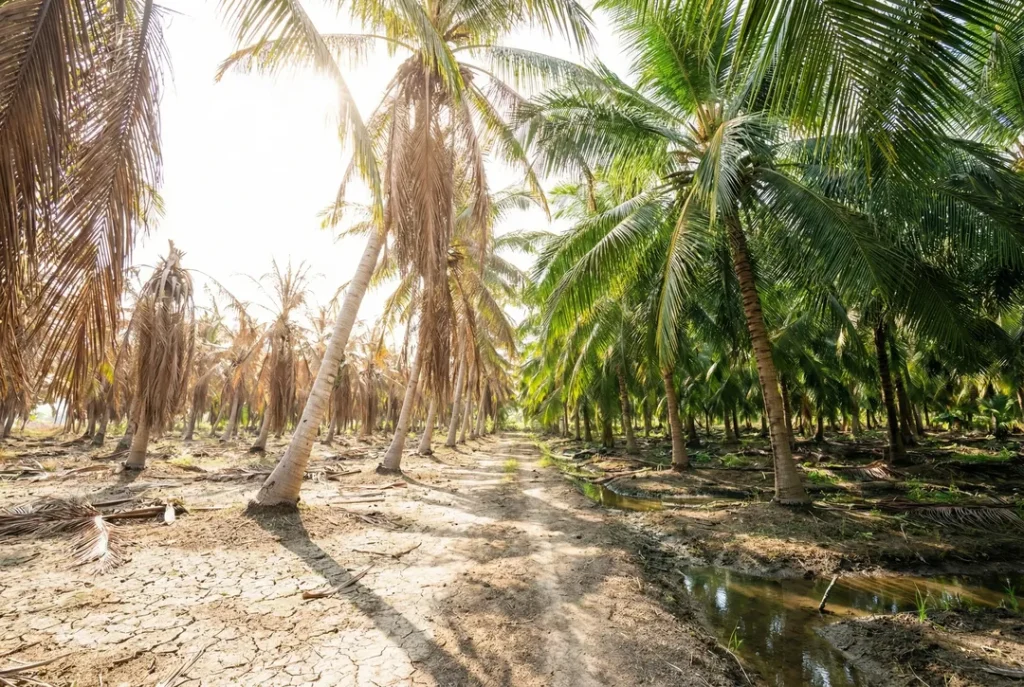
The dry season is the most critical time for Nam Hom farmers in Southeast Asia.
In Thailand, provinces like Ratchaburi and Samut Sakhon see almost no rain from December to May. Similarly, farms in Vietnam and the Philippines face hot, dry months from January to April.
For many growers, this is a season of lost income. But for smart growers, it is an opportunity to sell more than their competitors.
When the rain stops, your trees don’t just get thirsty—they go into survival mode. Export buyers demand consistent size, specific sweetness (Brix), and high water volume. A stressed tree cannot produce this.
Here is a detailed look at why Nam Hom trees fail in the heat, and how Low-Flow Precision Irrigation can save your harvest.
The Biology of “Nut Drop”: Why It Happens
To save your yield, you must understand how the tree works. Nam Hom trees are heavy drinkers; they need constant soil moisture to move nutrients from the roots up to the leaves and fruit.
When rainfall drops from 150 mm to just 20 mm per month, the soil heats up and roots begin to dry out.
The “Panic” Response
When a coconut tree senses a lack of water, it prioritizes its own survival over fruit production. This triggers a biological reaction:
- Pores Close: The leaves close their tiny pores (stomata) to stop water loss. This stops the tree from creating energy.
- Fruit Drop: The tree stops sending energy to flowers and young nuts. This causes “Nut Drop” or abortion.
- Less Sugar: Without water to transport potassium, the tree cannot produce the sugars needed for that signature Nam Hom sweetness.
The result? Flowers die, young nuts fall off, and the remaining nuts are small and tasteless. One week of severe water stress can damage three months of future harvest.
The Hidden Cost of Traditional Watering
Many farmers use flooding (furrow irrigation), sprinklers, or manual hoses. While these methods add water to the ground, they often waste money for three reasons:
- Too Wet, Then Too Dry: Flooding the field drowns the roots and cuts off oxygen. Then, the soil dries out completely. Nam Hom roots need a balance of water and air.
- High Evaporation: In hot months, surface water evaporates into the air before it reaches deep roots.
- Labor Costs: Finding reliable workers to water trees by hand is becoming difficult and expensive across the region.
The Solution: Low-Flow Precision Irrigation
The best way to handle the dry season is Precision Drip Irrigation specifically designed for Low Flow. Unlike flooding, which wets the whole field rapidly, low-flow irrigation puts water exactly where the roots are—slowly.
Imagine sipping a glass of water slowly all day versus having a bucket dumped on you once a week. Drip irrigation is the “sipping” method. It keeps the soil moisture stable, so the tree never feels stress.
Proven Benefits of Drip Systems:
- Save Water (30-60%): You use less water, but the tree absorbs more of it.
- Uniform Growth: Every tree gets the exact same amount of water. This leads to uniform nut sizes, which export buyers require.
- Less Labor: The system runs automatically. No hoses, no manual labor.
The “Secret Weapon”: Fertigation
This is how top farmers get the best prices. Drip irrigation allows for Fertigation (Fertilizer + Irrigation).
Instead of throwing solid fertilizer on dry soil, you dissolve nutrients directly into the water line. This feeds the roots immediately. This method is proven to boost Brix (sweetness), ensuring your nuts command a premium price even in the dry season.
Why We Recommend Netafim
Not all drip and sprinkler systems are the same. For commercial Nam Hom farms, Netafim is the global standard — and there’s a good reason for that.
At Jebsen & Jessen Turf & Irrigation, we recommend Netafim’s low-flow irrigation solutions because they are specifically engineered for Southeast Asia’s farming conditions and coconut crop needs.
1. Anti-Clogging for Southeast Asian Water Sources
Water from canals and rivers in our region often carries silt, algae, and organic debris. Netafim’s low-flow emitters use advanced flow-path engineering that prevents clogging even at very low discharge rates — something cheap brands struggle with. This means consistent water delivery, fewer blockages, and lower maintenance.
2. Better Water & Nutrient Efficiency (Low Flow = Less Waste)
Low-flow irrigation releases water slowly, allowing coconut roots to absorb more water and nutrients instead of letting them wash away. With high-flow systems, too much water is pushed into the soil too quickly, leading to runoff, nutrient leaching, and uneven moisture distribution. Netafim’s low-flow design maximizes water use efficiency, ensuring your fertilizer stays in the root zone where it belongs.
3. Pressure Compensation for Uniform Coconut Growth
Whether your plantation is flat or uneven, Netafim’s pressure-compensated emitters ensure each coconut tree receives the same amount of water, even at very low flow rates. This uniformity reduces tree stress and supports consistent yield quality across the farm.
4. Smaller System = Lower Investment Cost
Because low-flow systems move less water at a time, the entire irrigation network can be designed with smaller pumps, smaller pipes, and fewer large components. This reduces your upfront investment significantly while maintaining high performance — a major advantage for large Nam Hom plantations.
5. Built for Southeast Asia’s Tropical Heat
Netafim’s UV-resistant materials are engineered to survive years of intense tropical sunlight. Farms get longer system life and better return on investment compared to cheaper brands that degrade quickly.
[Learn more: Netafim Tree Crop Irrigation Guide]
How Much Water Does Your Tree Need?
This is a common question. While it depends on your soil, a general rule for a mature Nam Hom tree in the dry season is 40 to 60 liters per day.
Because we use low-flow technology, we deliver this volume slowly over a longer period. This allows the water to penetrate deep into the soil without running off, keeping the roots cool and active throughout the hottest part of the day.
Case Study: The 2023 Drought
During the 2023 drought in Ratchaburi, farmers using hose watering saw heavy nut drop. Their income went down because buyers rejected the small nuts.
However, farmers using Netafim drip systems kept their normal yield. The steady moisture allowed the trees to keep pumping sugar and water into the nuts. Buyers continued to purchase their crops at full price. This is the return on investment (ROI) of stability.
Your Pre-Drought Checklist
If the dry season is approaching, follow this plan:
- Install Drip Irrigation: Focus water on the root zone.
- Mulch: Cover the base of the tree to keep moisture in the soil.
- Weed Control: Remove weeds that steal water from your trees.
- Fertigate: Inject Potassium specifically to boost sweetness.
- Monitor: Check soil moisture regularly.
Need Help Designing Your System?
You don’t need to do this alone. Jebsen & Jessen Turf & Irrigation provides solutions for farms across Southeast Asia.
We can help you:
- Calculate the exact water needs for your soil.
- Design a low-flow layout that minimizes your pump and pipe costs.
- Select the right filters and emitters for your water source.
Don’t let the dry season dry up your income.
[Get a Free Irrigation Consultation Today]