
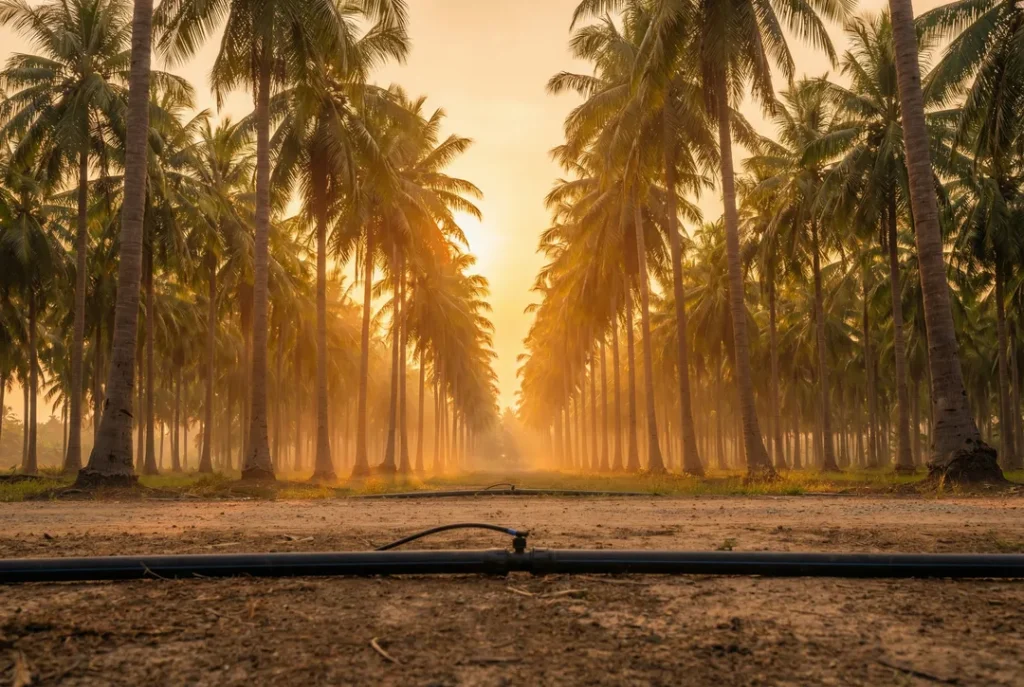
Drought is the single biggest threat to coconut farmers across Southeast Asia. It is a silent thief—often, by the time you see the physical signs of stress on your trees, the damage to your future harvest has already been done.
When the rain stops, the clock starts ticking. Trees get stressed. Nuts fall early. Sizes shrink. Sweetness drops. Ultimately, buyers reject the harvest, and your stable monthly income becomes unpredictable.
But drought does not have to destroy your yield.
While we cannot control the weather, we can control how our trees drink. This guide explores why traditional methods like sprinklers fail during the hottest months, and why Low-Flow Precision Irrigation is the regional standard for drought survival.
The Growing Drought Challenge in Southeast Asia
Climate patterns are shifting, and dry seasons are becoming longer and more intense. The impact varies by region, but the threat is shared:
- Thailand: December to May is critical, particularly for the Nam Hom heartlands of Ratchaburi, Samut Sakhon, and Nakhon Pathom.
- Vietnam: The Mekong Delta faces a double threat from January to April: lack of rainfall combined with saltwater intrusion.
- Philippines: Major coconut regions in Luzon and Visayas can lose up to 60% of their rainfall between February and May.
- Indonesia: Long dry spells hit Java and Sumatra from June to October.
During these windows, soil temperatures spike and moisture evaporates. Without intervention, your trees enter survival mode.
The Biology of Drought: Why Trees “Crash”
Coconut trees are resilient, but they have a breaking point. They need consistent soil moisture not just to survive, but to sustain the heavy energy load of developing flowers and heavy nuts.
The Lag Effect
The most dangerous part of drought is the “lag.” Because a coconut takes roughly 12 months to mature from flower to harvest, stress today ruins your income next year.
When water is low:
- Flower Abortion: The tree sheds developing flowers to conserve water.
- Premature Nut Drop: Young nuts fall within weeks.
- Size Reduction: The nuts that stay attached stop expanding.
- Brix Drop: Without water to transport sugars, the sweetness vanishes.
Sprinklers: The “False Friend” of the Dry Season
Many farmers rely on sprinklers because they are simple to install and visually satisfying—you can see the water flying. However, during a drought, sprinklers are often dangerously inefficient.
The Evaporation Problem
In hot, windy weather, 40% to 60% of sprinkler water never reaches the roots. It evaporates into the air or blows away before it hits the ground.
The Root Depth Problem
Sprinklers tend to wet only the top few centimeters of the soil. In a drought, this surface water evaporates rapidly. The deep roots—where the tree drinks from—remain thirsty. You are essentially humidifying the air, not hydrating the tree.
Additional Downsides:
- Weed Growth: Sprinklers water the spaces between trees, encouraging weeds that compete with your coconuts for nutrients.
- High Energy Cost: Sprinklers require high pressure, driving up your fuel or electricity bill.
The Solution: Low-Flow Precision Irrigation
If sprinklers are a shotgun approach, drip irrigation is a sniper. Specifically, Low-Flow technology applies water slowly, deeply, and directly to the root zone.
By keeping the soil moisture consistent, drip irrigation prevents the tree from ever sensing the drought. It creates a “safety zone” of moist soil around the roots, regardless of how hot the air temperature gets.
Why Low-Flow Drip Wins in a Drought:
- Efficiency: Less than 5% water loss. Every drop you pump goes to the plant.
- Deep Hydration: The slow release allows gravity to pull water deep into the soil profile, encouraging deep root growth.
- Salinity Management: For farmers in Vietnam facing saltwater intrusion, drip pushes salts to the edge of the wetting zone, keeping the immediate root area fresh.
Comparison: Water Efficiency
Feature | Sprinkler Irrigation | Low-Flow Drip Irrigation |
Water Loss | 40–60% (Evaporation/Wind) | < 5% |
Root Reach | Shallow (Surface only) | Deep & Stable |
Weed Growth | High (Waters everywhere) | Low (Waters only the tree) |
Drought Protection | Weak | Strong |
Economic Impact: Stability is King
Export buyers and large coconut water brands have strict quotas. They don’t care that it’s the dry season—they need volume.
Drought causes irregular harvests, missed quotas, and size downgrades. By switching to drip, you ensure:
- Predictable Yields: You hit your numbers every month.
- Consistent Quality: Uniform size and Brix mean fewer rejections.
- Market Power: Being the reliable supplier when others are failing gives you leverage.
The “Secret Weapon”: Fertigation
Drip irrigation also unlocks Fertigation—the ability to feed your trees through the water lines.
In dry soil, granular fertilizer sits on top of the ground, useless. With fertigation, nutrients are dissolved and delivered right to the hungry roots. This is crucial for maintaining tree health and Brix levels when the climate is trying to strip them away.
Regional Success Stories
Farmers across Southeast Asia are already shifting to this standard:
- Thailand: Nam Hom farmers are using drip to lock in the high sweetness (Brix) required for export.
- Vietnam: In the Mekong, drip is being used to maximize scarce fresh water and combat salinity.
- Philippines: Farms in Batangas are adopting drip to lower the pumping costs associated with expensive fuel.
Why We Recommend Netafim
Not all drip and sprinkler systems are the same. For commercial coconut farms, Netafim is the global standard — and there’s a good reason for that.
At Jebsen & Jessen Turf & Irrigation, we recommend Netafim’s low-flow irrigation solutions because they are specifically engineered for Southeast Asia’s farming conditions and coconut crop needs.
1. Anti-Clogging for Southeast Asian Water Sources
Water from canals and rivers in our region often carries silt, algae, and organic debris. Netafim’s low-flow emitters use advanced flow-path engineering that prevents clogging even at very low discharge rates — something cheap brands struggle with. This means consistent water delivery, fewer blockages, and lower maintenance.
2. Better Water & Nutrient Efficiency (Low Flow = Less Waste)
Low-flow irrigation releases water slowly, allowing coconut roots to absorb more water and nutrients instead of letting them wash away. With high-flow systems, too much water is pushed into the soil too quickly, leading to runoff, nutrient leaching, and uneven moisture distribution. Netafim’s low-flow design maximizes water use efficiency, ensuring your fertilizer stays in the root zone where it belongs. The result: healthier, more productive trees.
3. Pressure Compensation for Uniform Growth
Whether your plantation is flat or uneven, Netafim’s pressure-compensated emitters ensure each tree receives the same amount of water, even at very low flow rates. This uniformity reduces tree stress and supports consistent yield quality across the farm.
4. Smaller System = Lower Investment Cost
Because low-flow systems move less water at a time, the entire irrigation network can be designed with smaller pumps, smaller pipes, and fewer large components. This reduces your upfront investment significantly while maintaining high performance — a major advantage for large plantations.
5. Built for Southeast Asia’s Tropical Heat
Netafim’s UV-resistant materials are engineered to survive years of intense tropical sunlight. Farms get longer system life and better return on investment compared to cheaper brands that degrade quickly.
[Resources: Precision Irrigation Overview | Tree Crop Guide]
Need Help Choosing the Right System?
Every farm has different soil, topography, and water access. You don’t need to guess.
Jebsen & Jessen Turf & Irrigation can help you:
- Calculate the exact water requirements for your farm size.
- Design a low-flow hydraulic layout that saves energy and reduces pipe costs.
- Select the right filtration to protect your system.
Protect your farm. Protect your supply.
[Explore professional irrigation systems here]