
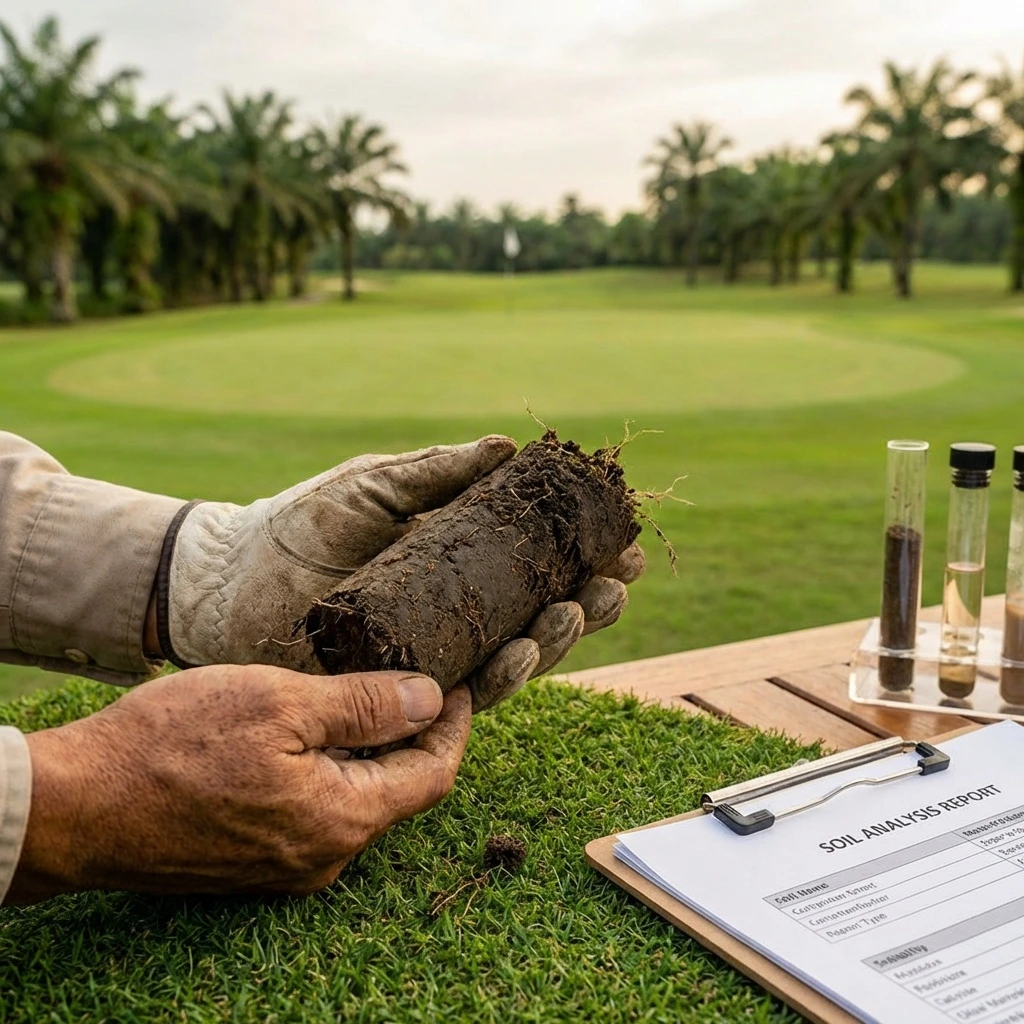
Everything above the grass line (colour, density, disease resistance) is decided below it. Soil dictates how turf absorbs water, takes up nutrients, and fights off stress. That holds whether you are managing a tournament-ready green in Sentosa or a municipal sports field in Chiang Mai.
A proper soil test replaces gut feel with numbers: pH, electrical conductivity, macro- and micronutrient reserves, cation exchange capacity (CEC), organic matter. Those readings tell you exactly what to apply, how much, and when, so you stop wasting product and start seeing results.
Below, we walk through what a professional soil analysis actually covers, why tropical Southeast Asian conditions demand a different playbook, and how to build an amendment cycle that pays for itself in turf quality and reduced inputs.
What Does a Professional Soil Test Actually Measure?
Chemical analysis. The lab starts with pH (how acidic or alkaline your soil is) because pH controls whether nutrients are available to roots at all. Electrical conductivity (EC) follows: it flags soluble salt build-up, a common headache on reclaimed land in Singapore or heavily irrigated coastal sites.
Macro- and micronutrients. Next come the big three: nitrogen (N), phosphorus (P), and potassium (K), plus secondary nutrients: calcium, magnesium, sulphur. Micronutrient assays for iron, manganese, zinc, copper, and boron round things out. Put together, these numbers show exactly where your soil can feed turf on its own and where deficiencies are holding growth back. Understanding how each nutrient drives essential nutrients for turf health is what separates a targeted programme from blind broadcasting.
Cation exchange capacity. CEC tells you how well your soil holds onto positively charged nutrient ions before they wash away. High-CEC profiles buffer against loss; low-CEC sandy rootzones (think USGA-spec greens) need lighter, more frequent feeds. Organic matter percentage completes the picture: it drives microbial activity, moisture retention, and slow-release nutrition.
Sampling protocol. On greens, pull at least 12–15 subsamples per green and composite them into one representative sample. For larger sports fields or commercial landscapes, 20–30 subsamples in a zigzag across the site gives you a reliable read.
The USGA recommends a minimum of three tests per year: pre-season, mid-season, and post-season, to capture nutrient trends and steer in-season adjustments.
Why Do Tropical Soils in Southeast Asia Need a Different Approach?
If your agronomic references were written for the US Midwest, they will mislead you here. Tropical soils across Southeast Asia operate under pressures that temperate models never had to consider.
Year-round temperatures between 28–35 °C mean organic matter decomposes two to three times faster than in cooler climates. In practice, that strips your soil’s nutrient bank and degrades structure far quicker than most maintenance budgets assume.
Then the rain hits. Intense monsoonal downpours flush water-soluble nutrients (nitrate-nitrogen, potassium, boron) straight through the rootzone before grass can take them up. We have seen sites in Malaysia’s Selangor region lose upwards of 60 percent of applied nitrogen within days of a heavy event. That is not a slow leak; it is money and product draining into the subsoil.
At the same time, heavy rainfall drives progressive acidification. Hydrogen ions displace base cations on exchange sites, pH drops, and nutrients like phosphorus and molybdenum get locked out of reach.
Here is where biology matters most. Soil health as a living ecosystem depends on microbial communities that cycle nitrogen, solubilise phosphorus, and suppress disease. Those communities are sensitive to pH swings and organic matter depletion, exactly the conditions tropical environments create.
Without targeted intervention (regular liming, organic matter replenishment, biostimulant applications), tropical soils can spiral downward fast. That is why learning about soil biology and microbial health is just as critical as understanding the chemistry. Biology drives the nutrient transformations that keep Bermuda, Paspalum, and Zoysia alive under equatorial pressure.
Building a Data-Driven Amendment Programme: From Test Results to Action
Baseline. Collect comprehensive soil samples and get them to a lab. You need current nutrient levels, pH, organic matter, and CEC on paper. These numbers are your starting point. Skip this step and every product decision that follows is a guess.
Set targets. Define agronomic goals based on your turf species, soil type, and end use. A Bermuda fairway on a sandy profile in Phuket needs a completely different nutrient balance than a Zoysia sports pitch on Jakarta’s clay loam. Use published guidelines for your grass type to lock in optimal ranges for pH, phosphorus, potassium, and secondary nutrients. These targets become the yardstick for every amendment decision.
Prescribe. Now match amendments to the gaps between your baseline and targets. On acidic tropical soils, common across much of the region, calcitic or dolomitic lime lifts pH while restoring calcium and magnesium. Controlled-release fertilisers are worth the premium here: they meter nutrients over 8–12 weeks instead of delivering one flush that the next monsoon washes away.
Getting pH right and using controlled-release fertilisers also improves photosynthesis efficiency, so turf converts sunlight into growth more effectively, a real advantage when you are managing year-round growing seasons.
Monitor and adjust. Re-test quarterly at minimum in tropical environments. Track whether your amendments are shifting values toward targets and adjust rates and timings based on actual trends, not a fixed calendar. Over two or three cycles, this feedback loop turns your programme into a precision system that cuts input costs while lifting turf quality.
How Often Should You Test Your Soil?
Three times a year is the floor: before the growing season kicks off, at peak growth, and after the season wraps. That rhythm captures the full nutrient cycle: depletion during active growth, leaching during wet periods, recovery after amendments.
The USGA endorses this three-test baseline, and Rutgers soil testing protocols for golf and sport turf recommend the same minimum.
In tropical climates where monsoon leaching is relentless, stepping up to four or six tests a year gives you much tighter control. High-value surfaces (tournament greens, national-level pitches) often justify monthly sampling during peak season. The cost of an extra lab test is trivial next to the cost of misapplied amendments or turf failure the week before a televised match.
Soil Health Across Industries
Professional sports. Sports organisations use soil data to keep FIFA- and World Rugby-compliant pitches playable through 40-plus match days a season. Without it, surface hardness and traction deteriorate well before the fixture list ends. In Southeast Asia, the rapid growth of professional football leagues has driven major investment in pitch quality. Bangkok’s Rajamangala Stadium and Singapore’s National Stadium both run year-round soil monitoring programmes to maintain playing surfaces under extreme tropical heat and monsoon conditions. Cricket grounds in Malaysia and Thailand face a similar challenge: high-traffic wicket areas require precise soil compaction data to meet ICC standards, and regular nutrient profiling ensures recovery between fixtures.
Landscaping and property management. Resort properties, government parks, and residential estates across the region use soil analysis to cut plant replacement costs and reduce irrigation consumption. Matching amendments to actual soil conditions beats following generic recommendations every time.
Agriculture. Soil health programmes drive crop yield optimisation, erosion control, and sustainable land management, critical for large-scale operations in Thailand’s Central Plains and Indonesia’s plantation belts. In Thailand’s Chiang Rai province, large-scale rice operations have adopted soil health monitoring programmes that reduced fertiliser spend by up to 20 per cent while maintaining yield targets. Palm oil plantations across Sabah and Sarawak now integrate regular soil biology assessments into their sustainability certifications, recognising that healthy soil microbiomes improve nutrient cycling and reduce dependency on synthetic inputs. Vietnam’s Central Highlands coffee estates face similar pressures: volcanic soils that once seemed inexhaustible show declining organic matter after decades of intensive cultivation, making structured soil testing essential for long-term productivity.
Civil engineering and remediation. Environmental remediation projects depend on soil testing to evaluate contamination, compaction, and drainage before a single excavator moves. The principle is consistent across every sector: measure first, then act.
Start Your Soil Testing Programme
Ready to stop guessing? Schedule a soil testing consultation with JJ TurfTech and get a clear picture of what your soil actually needs.
Our agronomists will design a testing and amendment programme tailored to your site, your turf species, and your climate, backed by laboratory data and decades of hands-on tropical turf experience across Southeast Asia.