
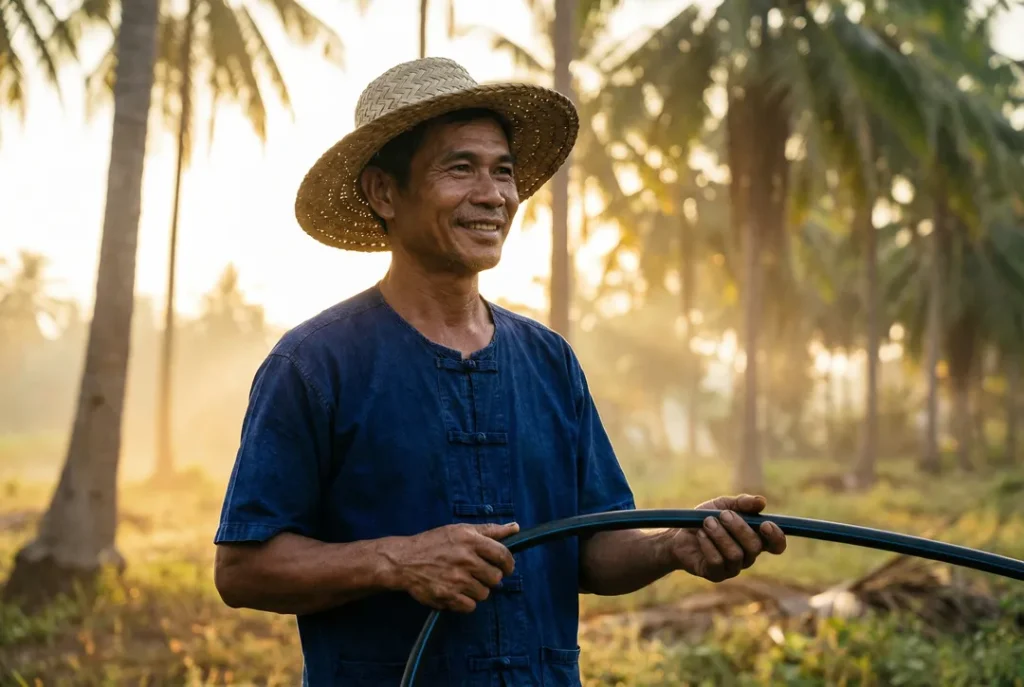
Extreme heat has become a harsh reality for coconut farmers across Southeast Asia. We are seeing temperatures climb past 40°C with increasing regularity in parts of Thailand, Vietnam, the Philippines, and Indonesia.
When the thermometer spikes, your trees react fast—and not in your favor.
Leaves turn brown and “burn.” Young nuts fall suddenly. Growth stalls. Suddenly, what looked like a promising harvest turns into a disappointing yield.
This guide explains, in simple language, the biology of heat stress and how the right irrigation strategy can act as a shield for your trees during the hottest days of the year.
The Biology: Why Heat Hurts Even Mature Trees
High temperatures do double damage: they dry out the soil and they overheat the tree’s internal systems. Even a mature 20-year-old palm cannot withstand prolonged 40°C heat without help.
What You See (Symptoms):
- Leaf Burn: Yellow or brown “scorched” tips or crispy patches on fronds.
- Nut Abortion: A sudden drop of young buttons or developing nuts.
- Poor Filling: Nuts that stay attached but have little water or meat inside.
What is Actually Happening (The Cause):
Farmers often blame the sun directly for “burning” the leaves, but the real cause is usually dehydration.
- The Cooling System Fails: Trees cool themselves by sweating water through their leaves (transpiration).
- The Supply Chain Breaks: When the heat is extreme, the leaves lose water faster than the roots can suck it up from the dry soil.
- The Shutdown: To save itself, the tree stops sending water to the extremities (leaf tips) and non-essential organs (fruit). The leaf heats up and cells die—this is the “burn.”
The “Nut Drop” Survival Mechanism
Why do young nuts fall when it gets hot? It is a calculated survival move by the tree.
If a tree is losing more water than it is drinking, it has to shed “weight.” Developing nuts require huge amounts of water and energy. By dropping them, the tree preserves moisture for its own survival.
This typically happens after one week of 35–40°C heat if soil moisture isn’t perfectly stable.
The Sprinkler Myth: Why Wet Leaves Don’t Help
Many farmers believe that to cool a tree, you must wet the leaves. This leads them to install large sprinklers. This is a mistake during a heatwave.
While sprinklers do cool the air slightly, they are inefficient when the heat is high:
- Evaporative Loss: In 40°C heat, up to 60% of sprinkler water evaporates before it penetrates the soil.
- Flash Cooling: Wetting a leaf cools it for minutes. Hydrating the roots cools the tree for the whole day.
- Shallow Roots: Sprinklers often fail to penetrate the deep soil where the main drinking roots live.
The Solution: Root Zone Cooling via Low-Flow Drip Irrigation
The most effective way to protect a tree from heat is internal cooling.
By using Low-Flow Precision Irrigation to keep the root zone deeply and consistently moist, you maintain the tree’s “turgor pressure.” This means the tree has a constant supply of water to sweat out through its leaves.
- Moist Roots = Cool Leaves: If the roots are drinking, the leaves can cool themselves naturally.
- Nut Retention: Because the tree doesn’t feel the water deficit, it doesn’t trigger the “abort fruit” signal.
- Soil Temperature: Drip irrigation keeps the soil damp and cool, protecting the sensitive feeder roots from baking in the hot earth.
Comparison: Heat Protection
Feature | Sprinklers in Heat | Low-Flow Drip Irrigation in Heat |
Water Efficiency | Low (High Evaporation) | High (Direct to Roots) |
Cooling Method | External (Ineffective) | Internal (Hydration) |
Soil Temp | Fluctuates rapidly | Stays stable/cool |
Nut Drop Risk | High | Low |
Regional Realities: What Farmers Are Seeing
- Thailand (Nam Hom): Farmers using drip irrigation during the April heatwaves report steadier nut sizes and volume compared to neighbors who flood or sprinkle.
- Vietnam (Mekong Delta): Here, heat often combines with saltwater intrusion. Drip irrigation is critical because it creates a “freshwater bulb” that pushes salt away from the roots, preventing the double stress of heat + salt.
- Philippines & Indonesia: Young palms are most at risk here. Drip irrigation has been proven to significantly lower mortality rates in young plantations during dry spells.
Why We Recommend Netafim
Not all drip and sprinkler systems are the same. For commercial coconut farms, Netafim is the global standard — and there’s a good reason for that.
At Jebsen & Jessen Turf & Irrigation, we recommend Netafim’s low-flow irrigation solutions because they are specifically engineered for Southeast Asia’s farming conditions and coconut crop needs.
1. Anti-Clogging for Southeast Asian Water Sources
Water from canals and rivers in our region often carries silt, algae, and organic debris. Netafim’s low-flow emitters use advanced flow-path engineering that prevents clogging even at very low discharge rates — something cheap brands struggle with. This means consistent water delivery, fewer blockages, and lower maintenance.
2. Better Water & Nutrient Efficiency (Low Flow = Less Waste)
Low-flow irrigation releases water slowly, allowing coconut roots to absorb more water and nutrients instead of letting them wash away. With high-flow systems, too much water is pushed into the soil too quickly, leading to runoff, nutrient leaching, and uneven moisture distribution. Netafim’s low-flow design maximizes water use efficiency, ensuring your fertilizer stays in the root zone where it belongs.
3. Pressure Compensation for Uniform Growth
Whether your plantation is flat or uneven, Netafim’s pressure-compensated emitters ensure each coconut tree receives the same amount of water, even at very low flow rates. This uniformity reduces tree stress and supports consistent yield quality across the farm.
4. Smaller System = Lower Investment Cost
Because low-flow systems move less water at a time, the entire irrigation network can be designed with smaller pumps, smaller pipes, and fewer large components. This reduces your upfront investment significantly while maintaining high performance — a major advantage for large plantations.
5. Built for Southeast Asia’s Tropical Heat
Netafim’s UV-resistant materials are engineered to survive years of intense tropical sunlight. Farms get longer system life and better return on investment compared to cheaper brands that degrade quickly.
[Resources: Precision Irrigation Overview | Tree Crop Insights]
Beat the Heat this Season
Don’t wait for the leaves to turn brown. Jebsen & Jessen Turf & Irrigation can help you prepare now.
We can assist you with:
- Choosing the best system for heat-prone sandy or clay soils.
- Designing a low-flow layout that ensures 100% coverage for every tree.
- Setting irrigation schedules that combat peak afternoon heat.
Heat is tough. Your trees don’t have to suffer.
[Explore irrigation options here]