
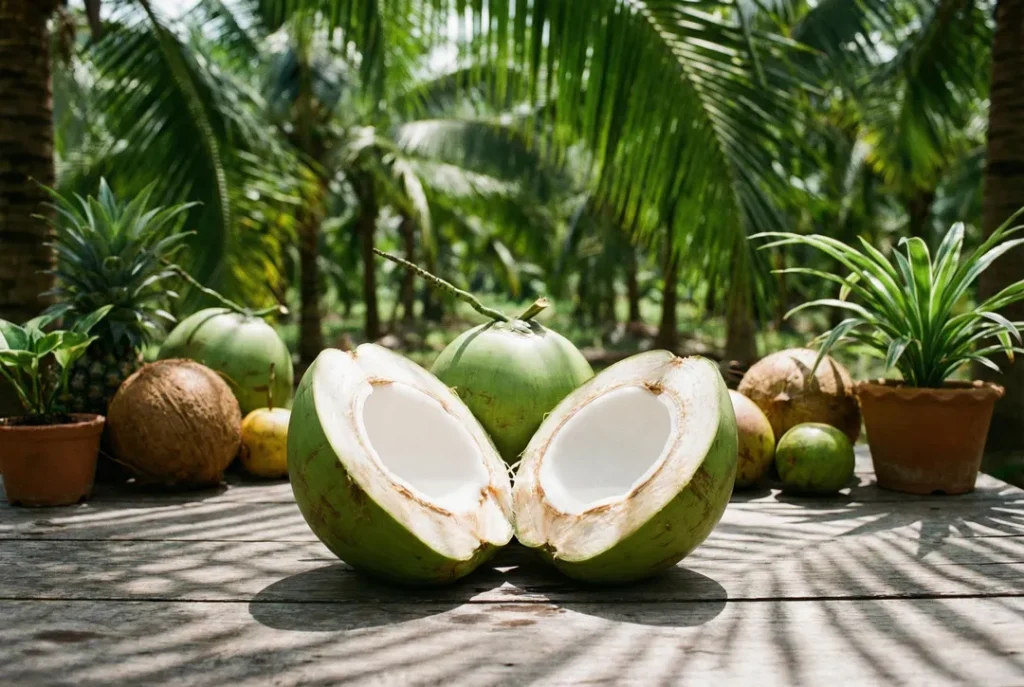
Farming coconuts in Southeast Asia is no longer just about planting and waiting for the rain. With longer dry spells, hotter seasons, and unpredictable weather patterns, water management has become the single most important factor in your farm’s success.
Irrigation isn’t just about giving trees a drink—it is the engine that keeps flowers alive, nuts growing, and your income steady.
This guide cuts through the technical jargon to give you exactly what you need to know to choose the right system for your land.
The Biology: How a Coconut Tree Actually Drinks
To choose the right system, you need to understand the tree. Coconut palms may look tough, but their root systems are surprisingly sensitive.
The “Active Zone”
Most of a coconut tree’s active “feeder roots” sit within the top meter of the soil. These are the roots responsible for drinking water and absorbing nutrients. Because they are shallow, they are the first to feel the heat when the sun bakes the ground.
The Stress Response
When this top meter of soil dries out, the tree doesn’t wait; it reacts immediately.
- Stalled Growth: The tree stops pushing energy to the nuts.
- Nut Drop: Tiny nuts fall long before harvest to save energy.
- Sugar Drop: Sweetness (Brix) plummets because water is the vehicle that moves sugar into the nut.
The Goal: You are not trying to flood the soil; you are trying to keep this top meter of soil consistently moist, like a wrung-out sponge.
The Numbers: How Much Water Do You Need?
While every farm is different, here are the general benchmarks for a healthy tree:
- Young Palms (1–3 years): 20–40 liters per day.
- Mature Palms: 40–60 liters per day.
- Peak Heat: Add 20–30% to compensate for evaporation.
Key Takeaway: It is better to give a tree 50 liters slowly over the course of a day than to dump 300 liters once a week. Consistency is key.
Comparing the Common Systems
There are three main ways farmers in Thailand, Vietnam, the Philippines, and Indonesia water their crops. Here is the honest breakdown of each.
1. Manual Watering (Hose or Bucket)
- Pros: Low upfront cost. Good for very small “backyard” plots.
- Cons: Extremely labor-intensive. It creates a “wet-dry” cycle where roots drown and then starve. It is almost impossible to maintain consistency during a drought.
2. Sprinklers
- Pros: Easy to set up and familiar to most farmers.
- Cons: The “False Economy.” Sprinklers are cheap to buy but expensive to run.
- High Waste: In hot weather, a huge percentage of water evaporates before it hits the ground.
- Weeds: Sprinklers water the grass between trees, forcing you to spend money on weeding.
- Shallow Hydration: They often wet the surface without penetrating deep into the root zone.
3. Low-Flow Precision Irrigation (Drip)
- Pros: Designed specifically for tree crops.
- Precision: Sends water straight to the root zone at a slow pace the soil can actually absorb.
- Efficiency: Uses 30–60% less water than sprinklers.
- Fertigation: Allows you to feed nutrients directly to the roots without leaching them away.
- Cons: Requires technical design (though this leads to cost savings on pumps/pipes later).
How to Choose the Right System for Your Farm
This is where many farmers make mistakes. Do not just buy what your neighbor has. Choose based on your specific conditions.
1. Based on Land Size
- Small Plots (< 5 acres): If family labor is free and abundant, manual watering can work. If not, simple drip kits are affordable and save time.
- Medium Farms (5–20 acres): Drip is the winner. At this scale, manual watering is impossible, and sprinklers waste too much fuel/electricity.
- Large Estates: You need a professional system. Using Low-Flow drip allows you to use smaller pipes and smaller pumps across the estate, significantly lowering your infrastructure investment compared to high-pressure systems.
2. Based on Water Source
- Limited Water: If you rely on a small pond or seasonal canal, Drip is essential because it stretches your limited supply twice as long as sprinklers.
- Dirty Water: If pumping from a river with silt/algae, you need Netafim’s clog-resistant emitters. Standard generic drippers will block up in weeks.
- Saline Water (e.g., Mekong Delta): Drip is safer. Sprinklers spraying salty water on leaves can burn the tree. Drip keeps the salt in the soil and pushes it to the edge of the root zone.
3. Based on Terrain
- Flat Land: Any system works, but drip remains most efficient.
- Sloped Land: Never use sprinklers. The water will run off downhill before it soaks in. Pressure-compensated drip emitters are the only way to ensure the tree at the top of the hill gets the same water as the tree at the bottom.
Why We Recommend Netafim
Not all drip and sprinkler systems are the same. For commercial coconut farms, Netafim is the global standard — and there’s a good reason for that.
At Jebsen & Jessen Turf & Irrigation, we recommend Netafim’s low-flow irrigation solutions because they are specifically engineered for Southeast Asia’s farming conditions and coconut crop needs.
1. Anti-Clogging for Southeast Asian Water Sources
Water from canals and rivers in our region often carries silt, algae, and organic debris. Netafim’s low-flow emitters use advanced flow-path engineering that prevents clogging even at very low discharge rates — something cheap brands struggle with. This means consistent water delivery, fewer blockages, and lower maintenance.
2. Better Water & Nutrient Efficiency (Low Flow = Less Waste)
Low-flow irrigation releases water slowly, allowing coconut roots to absorb more water and nutrients instead of letting them wash away. With high-flow systems, too much water is pushed into the soil too quickly, leading to runoff, nutrient leaching, and uneven moisture distribution. Netafim’s low-flow design maximizes water use efficiency, ensuring your fertilizer stays in the root zone where it belongs.
3. Pressure Compensation for Uniform Growth
Whether your plantation is flat or uneven, Netafim’s pressure-compensated emitters ensure each coconut tree receives the same amount of water, even at very low flow rates. This uniformity reduces tree stress and supports consistent yield quality across the farm.
4. Smaller System = Lower Investment Cost
Because low-flow systems move less water at a time, the entire irrigation network can be designed with smaller pumps, smaller pipes, and fewer large components. This reduces your upfront investment significantly while maintaining high performance — a major advantage for large plantations.
5. Built for Southeast Asia’s Tropical Heat
Netafim’s UV-resistant materials are engineered to survive years of intense tropical sunlight. Farms get longer system life and better return on investment compared to cheaper brands that degrade quickly.
[Resources: Precision Irrigation Overview | Coconut and Tree Crops Guide]
Need Help Planning Your Layout?
You don’t have to guess. Jebsen & Jessen Turf & Irrigation supports coconut farmers across the region. We can look at your land map and help you decide:
- How much water you really need.
- Whether drip or sprinkler fits your specific terrain.
- How to design a low-flow layout that lowers your pump and pipe costs.
Strong roots, stable moisture, better nuts—good irrigation is the foundation of your farm’s future.
[Explore irrigation solutions here]